Jay Byrne presentation: IABC Southern Region Conference

October 18th, 2011

On October 14th Jay presented background and case studies for  Online Research & Tactics for Digital Reputation & Issues Management to the IABC Southern Region Conference in New Orleans.    A copy of his slides are available here:

Jay Byrne IABC Southern Regional Conference 2011 (Adobe PDF – 3MB)

Talkers 2011 New Media Seminar

June 10th, 2011

A copy of Jay Byrne’s presentation to Talkers 2011, New Media Seminar can be downloaded here:

http://www.jaybyrne.com/wp-content/uploads/2011/06/Talkers-2011-Jay-Byrne.pdf.

I’ve been asked to provide an example of intersecting real world behaviors with new media tactics. So, let’s take Twitter. While some will use Twitter for customer service, others for one-to-one and one-to-network information sharing, the fact remains that most people aren’t using Twitter or going there in their day-to-day interactions.

But, something a significant volume of people do is search and scan news online. Twitter influences what stories we are likely to see in online news aggregator sites (e.g., Google News, Yahoo! News or your local newspaper’s website which pulls in those feeds) and has an influence in traditional search. Your tweets, if properly executed and syndicated, can play a role in this influence. If you want to know more, read on…

To tweet or not to tweet… consider taking two minutes to read this before you answer.

Like websites, then blogs, people have been rushing to Twitter as the next best thing now for a couple of years and often for the reason “because everybody is doing it…” As with anything, our reasons for investing our time and energy should be measurably linked to goals and not just following the crowd. I have this type of conversation with my pre-teen son and daughter every week; I never imagined I’d be having it with multi-billion dollar clients – but in the words of HL Mencken, “Nobody ever went broke underestimating the intelligence of the American people…”

If a goal is to create awareness, linked to opinion formations which eventually support beliefs upon which our target audiences act associated with our organizational or personal goals, then we should consider how and why microblogging (e.g., Twitter, Foursquare, Tumblr or microblogging features on Facebook and LinkedIn) can support that goal.

Like most social spaces, Twitter is first and foremost an “awareness” channel. Using this service you can create direct awareness of content for the people in your network and those to whom you extend your network using specific Twitter platform tactics (#hash tags, @directed tweets and RT re-tweets). However, the real value of Twitter is its power to influence broader awareness outside of the Twitter network where the majority of people reside.

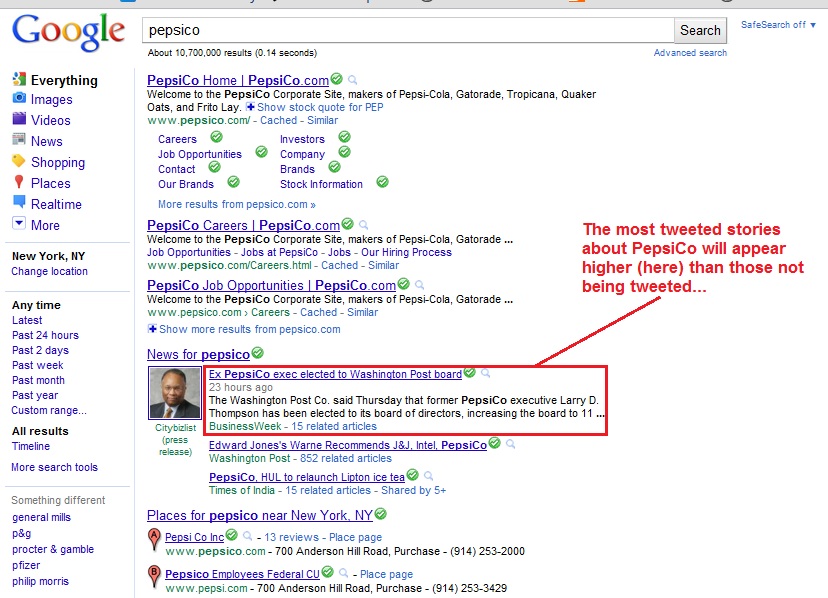
In 2009 Google made a minor investment in Twitter to gain access to their live and full stream of content for use in Google’s search and the Google News aggregator algorithms. Search engine algorithms use a variety of factors to determine what search results appears above others and – this is most important for Twitter and our interests – what news stories to display on top of others in their news aggregator portals (e.g., Google News and Yahoo! News). These algorithms now tap Twitter seeking keywords tied to hyperlinks associated with news to influence what news items show up on top of these news aggregators and the news portals which display their results.

News portals have significant and broad influence – the content from these sites is streamed to hundreds of thousands of local news websites and topic portals where the vast majority of consumers and influential public policy figures get their news today. News and search portals are critical opinion formation spaces which can then lead to desired belief formations in support of our goals.

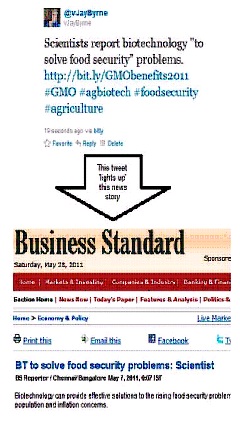
Twitter influences which stories appear and in what order they appear giving those who have effectively Tweeted first and with the most frequency (syndication) an edge on determining what the rest of the world sees on specific topics. Twitter can drive awareness AND help influence content that determines what opinions the public forms about a given topic.
News and search are influenced by Twitter

Now, only a small percentages of Tweets use effective tactics to influence search and news algorithms. If you aren’t able or willing to use these tactics effectively then the ROI on your time and energy will be limited. The two most important to consider are:

1. Inclusion of a hyperlink. On microblogs this typically involves using a URL shortening service like http://bit.ly (my preferred service).

2. Inclusion of a relevant keyword associated with the topic, to which you can also assign a #hash tag. By including the “#” pound sign or hash tag in front of a contiguous string of characters you can alert others on Twitter interested in that topic and create new visibility for your Tweet which can help syndicate your search and news influencing links.
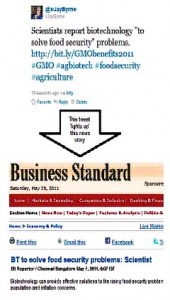
On any given day and for any given topic there may be numerous news reports (these can be from mainstream sources or simply blogs) associated with sustainable agriculture, biotechnology, etc… Typically, stories which have been amplified via Twitter with the following characteristics will have more influence than other stories:

• “First to be tweeted” – links to stories which hit Twitter first frequently appear as the top news. Speed matters.

• Most tweets (and re-tweets) – stories with the highest volume of links from Twitter frequently appear on top. Even if you aren’t an “early tweeter” you can help support those who are by re-Tweeting or re-posting their contents to your Twitter account. Size (volume) matters.

• Weight of tweets – the more people following your tweets (subscribers) gives them more weight. Further, you can add to this weight by linking your Twitter account to your LinkedIn, Facebook or other social media accounts so that your tweets are automatically syndicated to those networks. So “following” one another in our Twitter network and syndication within our other social networks, just like linking to one another’s blogs gives all of our tweets (whether we are tweeting or not) additional influence. Validation (followers) matters.

If you want to influence news and search and are willing to adopt one or more of the tactics which can make that happen, Twitter may provide you with a decent return on investment.
The Conference Board – Web 2.0 Conference New York

May 21st, 2010

A diverse and interesting conference with a long list of social media experts like Shel Holtz, Ed Garsten, Mary Henige, etc…  My presentation for Social Media Metris: Monitoring, Engaging and Analyzing Social Media can be found here.  Kudos to Lee Hornick and his team for another well thought and high value gathering.

http://www.jaybyrne.com/wp-content/uploads/2010/05/Byrne-v-Fluence-Conference-Board-May-2010.pdf

National Advocay Summit – Digital Health Care

May 18th, 2010

Jay Byrne presentation to May 2010 National Advocacy Summit gathering of health care and patient advocacy groups on digitial trends from blogs to beyond into the cloud.  A copy of his presentation materials is available by clicking here:  Digital Health Care 2010

http://www.jaybyrne.com/wp-content/uploads/2010/05/v-Fluence-Digital-Health-Technologies-2010.pdf

The Cable Show 2010 – Social Media Panel

May 11th, 2010

In a panel presentation sponsored by the Association of Cable Communicators entitled “Social Media as a Mainstay of the New Communications Mix” I shared brief slides and comments along side of New Media Minute moderator Daisy Whitney, Pam Slay of the Hallmark Channel, Alex Dudley of Time Warner Cable, and Rob King of ESPN.  A PDF copy (1MB) of my presentation slides is available here.

Healthcare “Apps” Exploding in Mobile, Are You Ready?

March 5th, 2010

Does your online monitoring cover new mobile app spaces? If so, you’re seeing what we are: i-Tunes’ Health & Fitness or Medical categories now contain more than 6,000 apps for iPhones. As of January 2010, there were more than 1,700 medical applications; all together, they’ve been downloaded by more than 1 million users.

Among these, there are hundreds of applications that reference virtually every major pharmaceutical brand name, offering services from basic prescribing data to “cost-saving” generic or over-the-counter alternative options. These have been developed by medical publishers, pharmacies, payers, hospitals, advocacy groups, alternative health promoters, health care professionals, litigators, government agencies and others. Virtually every therapeutic area is already represented with growing offerings for disease management. For example, Virginia Commonwealth University recently announced an application for physicians and patients to monitor daily asthma treatment routines.

Late to the game but starting to appear are apps from the pharmaceutical industry. When it comes to pharmaceutical company-branded apps, most are free of charge, while the costs of general healthcare-related apps for the iPhone range from free to $299. More specifically, 23 percent of all medical and health applications are available for free; the median price charged for the remaining 77 percent is $1.99.

You can read the rest of this article on v-Fluence.com.

Turning mobile consumers into food safety inspectors, clinical diagnosticians and more

July 24th, 2009
Using a Cellscope

Using a Cellscope to Check for Diseases.

The latest whiz-bang application for mobile users, CellScope, comes to us from researchers at the University of California, Berkeley, whose tool enables cell phone cameras to be used as fluorescent microscopes. This means that mobile devices with cameras, like the iPhone, can be adapted to collect and transmit images from blood and sputum (snot or spit) to diagnose the presence of malaria parasites and tuberculosis.

While this fluorescent scope device currently requires a plug-in component, we’re not so far away from software or camera upgrades that would make this adaptation accessible to any iPhone or android device user. Similar applications could easily include the detection of E. coli or other bacteria in food. Imagine that your ground beef smells a little off. Take a snap with your cell phone, and learn if you’ve got a contaminated Big Mac. How about H1N1 (aka, Swine Flu)? Sneeze, and snap a picture; diagnosis and links to related information, services or therapeutic products could be delivered in real time.

The possibilities that these types of mobile applications afford, which inform decision-making and influence behavior at the point of consumption, are endless. Are we ready for mass access and control over food quality or disease diagnostics, like the examples noted above? It won’t matter if we’re ready or not, it’s coming. I’ve written before on the demise of the PC being driven by mobile applications; this is just the latest nail in that coffin, which extends mobile’s reach well beyond where anyone could have predicted.

Continue reading the full post at the v-Fluence Company Blog

Growth in Mobile “Apps” Forebodes PC’s Demise

May 4th, 2009

Where the Web is heading and where you need to be

Not all of the more than 25,000 mobile applications (apps) currently available for the iPhone and other smart phone devices were intentionally designed to kill the PC; however, virtually all of them are training us for that eventuality. Point of consumption content opportunities and risks are booming and organizations that are not positioning themselves now for the related shifts will find themselves at significant disadvantages.

The demise of the PC will not surprise anyone who has studied the history of the ever-shrinking computer or my fellow boomers who still remember when the IBM Selectric™ dominated desktops over ThinkPads™. It may be harder for the X and Y generations to envision a completely PC-free world; however, they will be leading the way with their rapid adoption of mobile and other point of consumption interactive tools.

The key question for those seeking consumer and other key stakeholder influence is, “Where and when are their points of decision and consumption, and how do I effectively participate at those places and at those times?” For many, that transaction point will be via some mobile application interfacing with a smart phone, car GPS system or other Web enabled appliance or device. So, if you are still fiddling with finally launching that killer Web site or edgy corporate blog today, you can stop reading now – it’s unlikely you’ll be around to worry about this.

Continue reading the full post at the v-Fluence Company Blog

The Death of Print

April 2nd, 2009

What’s really endangered about newspaper publishing?

Predictions of the death of the American newspaper are appearing with greater and greater frequency, along with the actual demise of several well known dailies. The Rocky Mountain News recently ceased publication altogether and the Christian Science Monitor will move to an all-online publishing platform next month. The Web is the accused assassin and cause of this mainstream media crisis. It also is the primary driver behind traditional media’s search for a sustainable way to exist profitably online.

What many newspapers don’t realize is that they have yet to perfect the basic mission of successful Web publishing: Link relevant content with relevant audiences for increased ROI opportunities for relevant advertisers. When they do, they may staunch their current hemorrhage and – gasp – perhaps make money online.

Time Magazine has taken up the apparent demise of print journalism with a cover story and recent report predicting the potential demise of eight to 10 of the most endangered papers in the country. Time suggests these once-powerful media mainstays are close to shutting down or moving to online-only publications. But will just a shift to online publishing save them?

Continue reading the full post at the v-Fluence Company Blog

Skittles in Social Media: Key Lessons from a Bold, Ballyhooed Campaign

March 11th, 2009

From the v-Fluence Company Blog:

This past week we were talking about Skittles and an innovative campaign launched by the marketers at Mars, Incorporated, next week it will be something else. That’s the nature of our fleeting attention span and how the Web has helped whittle it into many minute buckets filled with fleeting bits and pieces of information – yes, even fruit-flavored rainbow colored ones.

For their part, the Mars marketers deserve acknowledgment: They took a bold step this week and embraced the fact that consumers, not the brand team, increasingly control their brand and image online. In fact, they’ve gone so far as to actually turn over the keys via their brand Web site, www.Skittles.com, which they re-launched largely as a navigation tool that overlays social media spaces where unfiltered, regular consumers are talking about their products.

Read the rest of this entry »

Search

Tags

  • Communication Resources

  • Online Marketing Resources

  • Other